The latest edition of “This Week In Space” is out!
Hello and Welcome. This week we have everything from NASA creating vomit in a lab to fire and smoke, and let’s cut right to those flames you want to see…
FIRE and smoke blasted out of the most powerful solid rocket motor designed for flight – a 5 segment solid rocket booster. This was a NASA and ATK test in Promontory Utah. It was a 75 million dollar test of a rocket that President Obama wants cancelled. This five segment motor was built to power the Ares I rocket meant to fly crews to space. This one blasted out a 600 foot long flame that was 5600 degrees and can generate up to 3.6 million pounds of thrust.
We LOVE an excuse to show catchy video anytime here at TWIS – and NASA just gave us two good reasons. The agency selected two companies for experimental space vehicle test flights…Armadillo Aerospace and Masten Space Systems and awarded them a total of about half a million dollars. The awards will be used by the two companies to test their systems near the edge of space. That’s considered to be the area between 65 thousand and 350 thousand feet. The CRuSR awards will fund two flights this fall and one this winter of Armadillo’s Super-Mod vehicle from Spaceport America in New Mexico. The first two flights will be to an altitude of approximately nine miles and the third to approximately 25 miles. A Masten Space Systems’ vehicle will make four flights this winter from the Mojave Spaceport in California. Two flights will reach an altitude of approximately three miles and two others will be to approximately 18 miles.
All good things must come to an end – and that was the case Monday for NASA’s ICESat spacecraft, which fell to Earth in a controlled re-entry over the Barents Sea. The spacecraft weighed about a ton, and NASA expected about 200 pounds of debris to survive the fiery plunge to the surface. Launched back in 2003, ICESat was an Earth Observing satellite designed to measure the thickness of both land and sea ice – as well as vegetation, clouds and atmospheric aerosols. Its laser instrument stopped working last year, and controllers fired on-board thrusters over the summer to adjust its orbit and bring it down in a safe and controlled fashion. And here’s a cool twist – NASA farmed out the planning work on the final maneuvers to students at the University of Colorado Boulder. It was a great project for them, and it saved some tax dollars too. ICESat 2 is on the books to launch in 2015.
International Space Station. Source: NASA
As long as we are de-orbiting things…Tuesday was trash day up on the International Space Station. In space it is a little more complicated than pushing the big green bin out to the curb. As you know, the station gets regular shipment of supplies via unmanned Russian Progress vehicles. Once the station crew members unpack all the cargo, they start packing trash back in. When it is full, the Progress undocks and Russian ground controllers eventually deorbit it and it burns up over the Pacific Ocean. The station crew waved bye-bye to Progress 38 in time to start preps for the arrival of Progress 39, set to launch from Kazakstan on September 8 and dock at the station two days later. Also on the ISS, astronauts were keeping an eye on hurricane Earl from 218 miles up…talk about a birds-eye view. And one more piece of station news before we move on. NASA crew assignments for Expedition 34 and 35. The headline: in March 2013, Canadian astronaut Chris Hadfield will assume command of the ISS – making him the first Canadian commander. Way to go, Chris, ‘eh?
The NASA family bid farewell this week to astronaut Bill Lenoir, who died at age 71 of head injuries sustained in bicycle accident. Lenoir was a “scientist-astronaut” selected in 1967, and he waited a full 15 years to make his one and only flight. In the shuttle program, he is a man of many firsts. He flew on the first “operational” shuttle mission, STS-5. The previous four were considered test flights. He and Joseph Allen were the first mission specialists to fly on the shuttle. He was the first flight engineer to assist the Commander and pilot during a launch on the flight deck. He switched seats with Allen for the return home, and so he was the first astronaut to ride back to earth on the middeck. He and his crewmates deployed the first commercial shuttle payloads into orbit – two communications satellites. And he and Allen were supposed to conduct the first spacewalks from the shuttle – but space sickness and suit malfunctions scuttled that plan. Lenoir went on serve three years as Associate Administrator for Space Flight.
Check out this super-cool visualization of the solar system that shows the location of asteroids over time as we earthlings discovered them. Here’s what our situational awareness was in the year 1980. But let’s skip ahead a bit. Discoveries really took off around the year 2000 or so. The ones in red are so-called Earth crossing asteroids – need to keep a particularly close eye on those. It’s like Yogi Berra said – you can see a lot by just observing. Another interesting asteroid tidbit this week. There’s been a lot of buzz in recent months about a possible manned mission to an asteroid, perhaps sometime in the 2020’s. Well, opportunities to do that may not be as plentiful as you might think. We can’t go to any just any old asteroid – we would need to choose one that’s got to be zipping through space at the right speed, its got to be spinning just right, viewable by ground-based telescopes, and reachable using a heavy-lift rocket that will presumably be developed between now and then. When you put all that up on the scale, you know how many suitable asteroid candidates there are for a manned mission in the 2020’s? According to the NASA Near Earth Object Office: Two. Of course, we may discover others. Which would be great. It’s always nice to have options.
Here’s a new view of a mysterious Martian crater, compliments of the European Space Agency’s Mars Express spacecraft. It’s called “Orcus Patera,” and scientists are not sure how it formed. A leading theory: it’s an impact crater from a small object that hit at a shallow angle.
Artist's rendering of MESSENGER at Mercury. Source: NASA
From Mars to Mercury. NASA’s MESSENGER spacecraft has been executing flybys of our solar system’s inner-most planet for the past couple of years, and is preparing to pull into orbit around Mercury next March for a year-long science mission. Here’s a MESSENGER image looking back at Earth snapped about 3 months ago, during its closest approach to the Sun. Check out the moon. Is that cool or what?
If you want to keep on top of missions like MESSENGER, NASA has a new iPad out called NASA App HD, free at the App Store. Among other new features, you can stream NASA TV live…and view images like that one we just showed you from MESSENGER in high resolution. Also, NASA has started putting more of its image archives up on Flickr. You’ll find a lot of new imagery up there, but also a fair amount of historical material too. Point your browser to our web site for a link. That’s spaceflightnow.com/twis
Here’s a story that really stinks. NASA is creating vomit in a lab. Really. So why does the space program need vomit? Here’s what researcher Nikki Williams at the Johnson Space Center told roving reporter and astronaut Mike Massimino.
We need to put all the trash you’d have on a space mission on that trash bag. That includes potentially vomit, diapers. It sounds like a baby place.
So it’s for a new trash bag test. There is a vomit recipe from medical research that NASA based their formula on. Fake vomit …eg…kinda makes me want to …(gags) nevermind…I’ll be ok. If you want to see more of NASA’s vomit research – come on you know you want to, head to our page spaceflightnow.com/twis.
Time for us wrap this up…I’m feeling a little sick. Don’t need any Odorama “scratch and sniffs” to go along with that story. Thanks for watching. If you like us, please consider tossing us a few bucks via Paypal at spaceflightnow.com/twis. Send us an email twis@spacelfightnow.com, tweet us @thisweekinspace. Check out the blog here.
Thanks so much to our sponsor, Binary Space. We really appreciate your ongoing support.
Join us again next time for all the news off the planet. We’ll see you then.
The latest edition of “This Week In Space” is now out. Please watch!
Source: Hubble Space Telescope
We begin with an arrival of a spacecraft that aims to tell us how the universe formed. The 2.1 billion dollar Alpha Magnetic Spectrometer arrived at Kennedy Space Center as it gets prepped for its flight to the Space Station. It will be mounted on the space station to search for antimatter, dark matter, and strange matter – and it will also search for cosmic rays. It’s a spacecraft that almost never made it to space after being built. The mission to fly it was canceled after the Columbia accident in 2003. But AMS had some strong supporters in Congress, and NASA managers reshuffled plans to fly it. It’s the last big piece station hardware to go up shuttle. Principal Investigator Samuel Ting of the Massachusetts Institute of Technology has high hopes for the science that AMS will conduct on orbit.
We have checked and rechecked and double checked the detector, and we are now quite confident, we will stay on the space station, for its lifetime. For the next 20 years when you look at space and see the space station, there is one very very precise detector to collect data.
AMS is scheduled to fly aboard Endeavour on what at the moment is the last scheduled space shuttle mission set for February 26th 2011.
But first things first, before STS-134 delivers the AMS to the station, Steve Lindsay and the STS-133 crew will be visiting the orbiting outpost on Discovery’s last flight to space. That mission is currently slated to lift off November 1st. OV-103 is currently in its Orbiter Processing facility undergoing final preps for rollover to the VAB on September 8th. The media recently got a chance to take a look at some of cargo they’ll be taking up to the ISS – including Robonaut 2, as well as the Permanent Multipurpose Module and an Express Logistics Carrier filled with spare parts and supplies. The crew was recently at KSC for a Crew Equipment Interface Test – that’s a last chance for the crew to personally look over the orbiter and payload before flight. For these final missions, NASA is getting the public involved in selecting some of the wake-up songs that rouse the astronauts out of bed every morning on orbit. Traditionally, crew members’ family and friends make the picks…but now you can get in on the action too. Check out songcontest.nasa.gov for details. And a final word before we leave shuttle behind, NASA has not yet officially announced whether or not the Atlantis will get one final flight next year, but they are kicking a prospective schedule. You might want to pencil June 28, 2011 on your calendars for STS-135. We’ll you know when you can ink that in.
International Space Station. Source: NASA
Meanwhile in space, things are getting back to normal and science activities have resumed now that the International Space Station’s radiator problems have been put to bed. With flight engineer Shannon Walker at the controls of the station’s robotic arm, astronauts Doug Wheelock and Tracy Caldwell Dyson conducted three marathon spacewalks to swap out a failed ammonia pump that shut down half the station’s cooling system for a couple of weeks earlier this month. The spacewalkers hit some frustrating snags while trying to disconnect the broken pump, especially a balky ammonia line called M3 that repeatedly stuck in place, and leaked ammonia as well. Afterward, Wheels said the secret to their ultimate success was going out the hatch with the right attitude about unexpected problems.
I think the greatest thing that I’ve learned on my earlier EVA’s is just to expect that, just take a deep breath, think about different ways that you can finesse the piece of hardware and listen to what your ground trainers are telling you from the ground, and don’t give up trying. And so we kept at it. M3 became my giant through this whole thing that I had to face out there. And we did it together and we needed both of us on either end of the line to get it, to just find that sweet spot to mate it up and demate it as well. So I don’t know it sort of became the villan for us, and we sort of needed a villan to fight against when we were out there and it became a real challenge for us and we were able to rise to the challenge as a team.
SpaceX has conducted a high-altitude drop test of its Dragon spacecraft designed to ferry cargo – and eventually crew – to the ISS. An Erikson “Air Crane” helicopter dropped a Dragon test article at an altitude of 14,000 off the California coast to test the capsule’s parachute system as well as recovery operations. SpaceX says the exercise met 100% of test objectives. SpaceX successfully launched a Falcon 9 rocket carrying a dummy Dragon spacecraft into space in June. The company is planning another launch later this year that will put an operational Dragon into orbit, and return it to Earth.
The Mars Science Laboratory rover – also known as Curiosity – continues to take shape in its clean room at NASA’s Jet Propulsion Lab. Engineers have now attached its robotic arm. It was so heavy that they had to hoist it into place using a crane. The arm is tipped with a suite of instruments including a camera, a spectrograph and a drill that will core out and deliver samples to other instruments on the rover’s deck. Curiosity is set to launch to Mars late next year.
And speaking of Mars launches, it was thirty-five years ago that NASA launched the Viking missions to Mars – Viking 1 on August 20th and Viking 2 on September 9th, 1975. Each probe consisted of an orbiter and lander. In their day, Viking 1 and 2 were the most successful interplanetary probes ever deployed to the red planet – beaming back color images of the Martian surface and scooping up soil samples for analysis. It would be nearly 20 years before Mars Pathfinder returned for further exploration of the surface.
Artist's rendering of Kepler 9. Source: NASA
The holy grail for astrobiology buffs is finding an Earth-sized, Earth-like planet. That hasn’t happened yet (we’ll be leading the show with it when that happens!) but there are a couple of interesting developments on the planet-hunting beat this week. Scientists working with the Kepler spacecraft have identified a planetary system orbiting a sun-like star called Kepler 9. The new solar system includes two Saturn-sized gas giants and possibly a slightly-larger-than-earth sized planet orbiting very close to the star. No chance of Earth-like conditions though…it’s just too hot. Also this week, researchers working with the European Southern Observatory announced they’ve identified a solar system with at least five and maybe as many as seven planets orbiting a sun-like star located 127 light years away in the constellation Hydrus. And one of those two unconfirmed planets is thought to be roughly Earth-sized and also orbiting very close to its sun. Again, too hot for life. So we’ve got new solar systems breaking out all over. No pale blue marbles though.
Erupting volcanoes have been in the news this summer – and no I am NOT going to try to pronounce the name of that volcano in Iceland. But take a look a cosmic volcano, erupting out of the black hole at the center of galaxy M-87. These images from the Chandra X-Ray Observatory combined with radio telescope data from the Very Large Array show the black hole blasting gas and energy out. The good news – air travellers in Europe have nothing to worry about with this volcano – it’s 50 million light years away.
And finally, we leave you with this time-lapse video of earth from space, shot by NASA astronaut and Mr. “Saturday Morning Science” himself, Don Pettit. I’ve spent my whole career in TV and I can tell you, most everything looks better in forward. Turns out Earth is no exception. Night is even cooler than day. Check out those green auroras when they zip by…absolutely incredible. Pettit is headed back for a second tour of duty on the ISS next year. What are you going to wow us with next time, Don? It’s going to be hard to top this!
Time for us to hit the stop/eject button for this week. Thanks for watching…please check us out regularly. Also, please think about tossing us a few bucks at spaceflightnow.com/twis, we’re kind of singing for our supper here with this show..send us an email twis@spacelfightnow.com, tweet us @thisweekinspace. Check out the blog here. Thanks so much to our sponsor, Binary Space. We really appreciate your ongoing support. Join us next time for all the news off the planet. Miles O’Brien will be back next week – we’ll see you then.
Check out the latest edition of “This Week In Space.”
International Space Station Source: NASA
Hello and welcome – they call them quick disconnect valves – but apparently on the International Space Station – they don’t always live up to their name. One of them – that connected a faulty ammonia pump to the station’s cooling system sent NASA into a tiger team frenzy of troubleshooting and head scratching this week. first time they tried to disconnect it – it spring a huge leak of ammonia – nasty stuff…so they reattached it and then tried again on the next walk – at first it wouldn’t budge. But in the end, the solution was precisely what you or I would have done if it was a pipe under the sink at home – they shook the darn thing like crazy until it came free. Spacewalker Doug “Wheels” Wheelock employed the elbow grease – spacewalking sidekick Tracy Caldwell Dyson was at his side. It was the second spacewalk to replace the pump and get that cooling system back on-line. When it failed – the station still had one other set of operative radiators – but the reduced capability created a significant brown out for the 6 person crew.
Veteran astronaut and spacewalker Dave Wolf was helping lead the effort on the ground to figure out how to solve case of the stubborn valve. I spoke with him via Skype.
Former NASA Administrator Sean O’Keefe and his teenage son Kevin survived a horrific plane crash in Alaska this week that killed five people, including former senator Ted Stevens. They were on a fishing trip when the amphibious twin otter they were in plowed into the side of a mountain in bad weather. Both O’Keefes are banged up pretty badly but are expected to survive. Sean served as NASA Administrator from 2002 to 2005 – he was sent there by the Bush White House to tighten the reins on the space station budget. He ended up leading the agency through the Columbia accident – and offered up a text book example of expert crisis management. Sean was the man who signed on to the idea of sending yours truly to space – an idea that ended with the loss of Columbia. He is a good friend – and I wish him and Kevin a speedy recovery.
A dawn rocket launch from the Cape Canaveral Air Force Station lit up the sky over central Florida Saturday. That’s an Atlas V rocket, and the payload is the AEHF-1 satellite. Its one of what will be a network of four military satellites designed to provide global, secure, protected and jam-resistant communications for our armed forces. Hopefully our troops will have better communication than i get with AT&T on my iPhone.
Good news Space Tweeps. – it’s official NASA will hold another tweet-up at KSC for the next shuttle launch – that’s STS-133, currently scheduled for November 1 (but you knew that). They are fantastic events – and if you are prone to tweet – you really should put your 140 characters in the ring. This is a good way to satisfy your assignment to see a shuttle launch before it is too late. Registration opens at noon on Tuesday, August 24, and closes at noon on Wednesday, August 25. If you want to know more, go to www.nasa.gov/tweetup.
Hard to believe it’s now been six years since the Cassini spacecraft arrived at Saturn. And it is still a very busy space probe. So busy it just got another extension – through 2017 – giving it a chance to observe the summer solstice in Saturn’s northern hemisphere. Here’s a cool new movie from Cassini. The spacecraft was getting some close-up images of Saturn’s F-ring, and purely by chance captured these images of a globular star cluster passing though the field of view. That’s NGC 5139, or Omega Centauri – nearly 16 thousand light years away.
As long as we are talking clusters – here’s a long exposure Hubble Space Telescope image of a galaxy in the Coma Cluster, 320 million light years away. this is a spiral galaxy called NGC 9411 captured face-on. And the Hubble folks have all kinds of questions about this picture of NGC 4696. This galaxy is not a perfect spiral – in fact it curls around on itself, kind of like a question mark. Astronomers are scratching their heads about it – they have all kinds of questions about why it is shaped so strangely, and what those filaments that stretch out from it might be. We’ll let you know if they find some answers…
Hubble is a third of the triumvirate of telescopes NASA called the Great Observatories – the other two are Chandra, and Spitzer – together these space scopes see the universe in the optical, x-ray and infrared wave lengths. Now imagine if they could work together – like the Justice League – This is a composite image – a super-space-scopes mash-up – of two colliding galaxies located about 62 million light years away. The Chandra data is in blue, the Hubble data in gold and brown, and Spitzer data in red. These so-called Antennae galaxies started colliding about 100 million years ago…and they are home to highly active star-forming regions. to infinity and beyond indeed!
Mars. Source: Hubble Space Telescope
Two anniversaries worth noting this week. Fifty years ago, NASA launched Echo-1, it’s first communications satellite. It was basically a big mylar balloon – able to bounce television, radio and TV signals cross-country and even across continents. And five years ago, the Mars Reconnaissance Orbiter launched from Cape Canaveral. MRO has become a workhorse for NASA – imaging the surface of Mars with unprecedented clarity, scanning for minerals and water, monitoring Martian weather, and serving as a communications relay for robotic missions on the surface.
Which brings us to our favorite simulated Mars mission – well I guess it’s the only simulated Mars mission – you know it by now – 6 men entered a human sized hamster habitat in Moscow – and will spend 520 days there pretending to go to Mars, explore the surface and then come back. We have now gone past the seventy day mark – which means they are about 15 percent done! and the video diaries they are posting on YouTube show no signs of reality show style discontent. Here is Romain Charles showing one of the…er…highlights – air sampling:
So Romain what’s up with the white socks and sandals and the wife beater t-shirt? I think that is a fashion don’t on Mars as well…just saying.
And on that note – I am outta here – you can email us a twis@spaceflightnow.com – or tweet us @thisweekinspace – the blog version of this podcast is at milesobrien.com. But here is the most important thing – please go to spaceflightnow.com/twis – and send us a few bucks – we really need you help – and if you don”t i’ll start wearing a wife beater – and white socks and sandals. Is that extortion? Sorta, I suppose. thanks to our most loyal sponsor ever – Binary Space – we really appreciate your support. We’ll see ya next time.
The latest edition of “This Week In Space” is out! David Waters is in for Miles O’Brien this week.
International Space Station. Source: NASA
One spacewalk down, at least one more to go in NASA’s efforts to remove and replace a failed ammonia pump that’s crippled part of the International Space Station’s radiator system. Astronauts Doug Wheelock and Tracy Caldwell Dyson conducted the longest spacewalk in station history – 8 hours, 3 minutes – attempting to switch out the pump with a spare. Unfortunately, removing the ammonia umbilicals from the old pump turned out to be a lot more difficult that anticipated, and there was significant ammonia leakage from one of the lines as well. The spacewalkers quickly fell behind on the timeline. In the end, they had to wrap up the EVA with the broken pump still in place. Ground controllers are now regrouping, and will need to re-plan the second spacewalk to try to make up for lost time. And ISS Program Manager Mike Suffredini says a third spacewalk may be in the offing.
I will tell you we’ve lengthened the amount of time from now until we get this pump running. I would tell you that it would take a lot of good luck, and somebody coming up with a really short tweak to the EVA for us to get to the point that we could start that ammonia pump after the next EVA. I really do think we are going to end up with three EVA’s. So I think we are going to end up being in this condition, this risk posture, a few more days than we had originally planned.
There will be no doubt be developments in this story daily. Please check in with us at Spaceflight Now for all the latest news.
The full Senate approved its compromise version of the NASA authorization bill for the 2011 budget late on Thursday – by voice vote with no discussion – and then they skedaddled out of town for the August recess. The Senate legislation would add a final shuttle flight to the manifest, extend the life of the space station through 2020, fund commercial space activities, and start work on a new heavy lift rocket that’s supposed to be ready for orbital missions by the end of 2016. But, the forward plan for the space agency remains in limbo for the foreseeable future. The House of Representatives, is working on its own, very different, version of a plan…that preserves key parts of the Constellation program, slashes funding for commercial space, and puts that heavy-lift rocket championed by the Senate on the back burner. The soonest the full House will vote on their version is September – and then compromise legislation will have to be hammered out in a conference committee. So…if you are holding you breath for this all to be wrapped up soon…it’s gonna be a while.
While the wheels of government turn slowly, workers at the Kennedy Space Center are getting pink slips as the shuttle program winds down. Commerce Secretary Gary Locke toured KSC this week along with NASA brass and Representative Suzanne Kosmas of Florida. Locke sits on a White House task force aimed at improving the economy on the Space Coast as the clock ticks down for shuttle. He met with about a dozen workers who will soon be hitting the unemployment lines. The task force will be submitting a report to Obama this month on the prospects for helping the workforce through the tough transition ahead. Let’s hope they can come up with some good ideas.
And speaking of shuttles, it seems we are all going to have to wait a little longer to hear from NASA where the orbiters are headed after the program ends next year. The agency had said it would announce in July which museums would get shuttles – but that deadline has come and gone with no word. NASA spokesman Mike Curie told our friend Robert Pearlman over at collectSPACE that a final decision has been postponed because the dates for the final two shuttle missions have slipped…and while the powers-that-be ponder whether or not to add an additional flight for Atlantis next summer. Here’s what we know: the shuttle Discovery will be going to the Air & Space Museum, which means NASA shuttle test article, Enterprise, currently housed there but never actually flew in space, also becomes available. We’re in standby mode to find out where Atlantis and Endeavour will, er, land.
The latest edition of “This Week In Space” is out. Give us a watch!
International Space Station. Source: NASA
Hello and welcome – Space is a big place to be sure – but we humans have done a pretty good job making a mess of low earth orbit. This past week the crew on board the Space Station nearly had to suit up and head for the Soyuz lifeboats when the guys at space command determined a chunk of that weather satellite the Chinese purposely smashed to smithereens in 2007 was on a collision course – after a few false alarms – the crew got the all clear…turns out the debris came no closer than about 5 miles – or 8 kilometers. Guess that is one Chinese export we’d rather not be .
And a pair of Russian Cosmonauts added to the litter problem during a spacewalk outside the station this week. Fyodor Yurchikhin and Mikhail Kornienko were replacing an old ratty TV camera and plugging in some cables on that new module called Rassvet. So what did they do with the old camera – they gave it the heave ho – who knows, maybe it will clonk a Chinese satellite…
Every spacefarer worth his or her salt is tweeting these days – and so it goes for an astronaut made of metal, plastic and silicon – Robonaut 2 – The humanoid robot slated to fly to the station in November opened his twitter account this week. You can follow him @AstroRobonaut.
Following all the twists and turns in the NASA budget saga -is a task worthy of a rocket scientist – or a purveyor of pork barrel largess…The latest news comes from the House this week…there was talk of a vote right before the recess to gut the Obama plan to spur a commercial space industry. Those who support the notion of creating fought hard to stop that vote. SpaceX CEO Elon Musk sent out an email plea saying in part:
The only hope for the average citizen to one day travel to space is in danger due to the actions of certain members of Congress…
Musk urged supporters of commercial space to call their Congressman. But oddly – did not mention the subject when he appeared on the Colbert Report the other night. Apparently Colbert is a Musk booster…
The latest edition of “This Week In Space” is available for your viewing pleasure. Please take a look!
[youtubevid id=”cxhdZjB48B0″]
Atlantis lands. Source: NASA
Hello, and welcome. Our theme this week is detente – as in the easing of hostilities between rivals. It is what we saw in space 35 years ago this week when Apollo and Soyuz joined together in low earth orbit – and it is what we are seeing unfold over the past few days in Washington – as Congress and the White House try to compromise on what is next for NASA after the shuttles are retired. The Senate Commerce Committee unanimously approved an authorization bill that embraces much of the white house space vision – with some key differences: Under the Senate plan, NASA will launch Atlantis one more time next year…meaning there are three shuttle missions remaining. NASA will begin work on a heavy lift rocket immediately – not in 2015 as Obama had promised. As for the similarities: Ferrying cargo and astronauts to low Earth orbit will still fall to commercial companies, the ISS gets a lease extension to 2020, and there is more money earmarked for space and earth science and aeronautics. The man leading the charge on this Senator Bill Nelson of Florida. He bristled when reporters suggested the new plan mandates NASA do exactly what the Augustine Commission warned against: throwing out Constellation to start work on an underfunded new rocket.
What this does is set up a new heavy lift vehicle, on a deadline of December 31, 2016, and this is achievable because of the policy that has been set by the committee. The committee cannot tell NASA how to design a rocket, but we can give policy direction to the executive branch of government, and we’ve done that in the bill. Using shuttle derived technology, building on that, making it evolvable, not building the largest rocket around but starting in the range of 75 to 100 metric tons, that is evolvable, and that would be built over the course of those six years within a budget of 11 and a half billion dollars. Now that is doable. And if anybody tells you that it is not, then if I were you I’d question their particular agenda.
In the interest of detente – the White House released a statement – saying in part – the Senate bill “represents an important first step towards helping us achieve the key goals the President has laid out…“We look forward to continuing to work with Congress to help advance an ambitious and achievable space program, one that helps us blaze a new trail of innovation and discovery.”
Apollo-Soyuz Test Project. Source: NASA
Thirty five years ago this week, they were blazing a whole new trail in space – when two space capsules – a Soviet Soyuz and an American Apollo rendezvoused and docked in low earth orbit. The Apollo Soyuz Test Project captured the attention of the world – as the two nuclear superpowers put their differences aside – and found they had much in common. This past week the surviving crew members came to New York City – to the OMEGA Watch Boutique on Fifth Avenue to celebrate the anniversary – hey what better place to mark a moment in time??
What they accomplished on their mission planted the seed for the international space station. U.S. Commander Tom Stafford flew with two rookies – one of whom was his boss – the late Deke Slayton – one of the original Mercury Seven – was grounded for years because of a heart murmur – but finally got a clean bill of health. Also on board Apollo: Vance Brand – who later commanded three shuttle missions. The Soviets were led by Alexey Leonov – the first person to walk in space. He flew with Valery Kubasov. The three of them gathered for a panel talk in the OMEGA Boutique – yours truly served as moderator. Unfortunately Alexey Leonov was not feeling well – and could not join us.
Thanks to OMEGA for hosting that great event – as you probably know, the company has a long, rich history with human spaceflight.
In fact, there would not be an international space station without Apollo Soyuz – and while the Senate bill we told you about envisions another mission for Atlantis – until that happens the Endeavour sts-134 mission is still the last in line – and the external fuel tank that will power that shuttle to orbit arrived at the Kennedy Space Center a few days ago – after a safe voyage across the BP tainted gulf. The mission is set to fly at the end of February.
The latest edition of “This Week In Space” is now available for your viewing pleasure. Please give us a look…
[youtubevid id=”ZSXeQY7KhuI”]
ET-138 rolls out at the Michoud Assemby Facility. Source: NASA
Hello and Welcome. We begin with a big orange caboose – if you will. The last space shuttle external fuel tank on the manifest made its way out of the barn at Michoud Assembly Facility in New Orleans. The tank is known affectionately as ET-138…but you can can call her “E” if you like. Tank builder Lockheed Martin pulled out all the stops for this one – hundreds of workers were on hand while a brass band played. The tank will ride on its custom barge to the Kennedy Space Center where it will be mated with Endeavour, now slated to fly the final shuttle mission N-E-T – or no earlier than – February 26th, 2011. Now there is one more tank that will be shipped from Michoud – it will be used by Atlantis should the Endeavour crew get in a jam – and need a lift home. And this is where I get to put in my plug for flying that tank – with Atlantis – one more time. Why not? And this is also where I get to nag you: if you have not seen a shuttle ride the fire to orbit – you are assigned to be at one of the last launches. No excuses. There will be a test later.
Tanks for the memories – I guess – prime shuttle contractor United Space Alliance announced its largest layoff to date – 15 percent of its workforce. Most of those employees are in Florida – since that is where most of their employees live. Somewhere between 800 to a thousand wrench turners and pad rats will be getting pink slips. Another 400 or so will be sacked from other USA operations. More cuts, are expected of course as the program winds down.
And that would explain the turnout at recent job fairs at KSC – somewhere between 2 and three thousand shuttlers showed up to press the flesh and hand deliver some resumes. About 60 public and private sector employers showed up. Can you guess which company had the most popular booth? Why that would be a certain California based launch company called SpaceX. Better SpaceX than ex-space I suppose.
If any of those jobless USAers are space history buffs – and I know there are more than a few you – you may want to consider this job: official NASA historian. apply at USAjobs.gov by the 13th. Also in the comings and goings department – NASA’s Wayne Hale is hanging up his headset but we hope not his keyboard – the veteran flight director, shuttle program manager – and eloquent blogger says its a personal decision. I sure hope he keeps sharing his pearls of wisdom with us. And the Hubble repairman just added another line to his long resume – John Grunsfeld is now a research professor at Johns Hopkins. he will keep his gig down the road as the number two man at the space telescope science institute – which is Hubble Science Central. Hey if he can’t multi task – who can?
The latest edition of “This Week In Space” is now available – give us a watch.
[youtubevid id=”e8dh7ntcFNo”]
Discovery launch. Source: NASA
Hello and Welcome. we begin this week with shuttle manifest destiny…and the movable feast that the last days of STS launching has become. It now appears the next shuttle flight – Discovery flying the STS-133 mission – will launch on October 29, and the STS-134 flight of Endeavour moves to February 28 of next year. An official announcement is expected on July 1st. The reason for the delay: scientists need some time to put the finishing touches on the final shuttle payload to the station – the Alpha Magnetic Spectrometer, a particle physics experiment. But we use the word final with some caution – as NASA has not ruled out an encore mission for Atlantis. Look for a decision on that in August.
Of course there are a lot of people out there who would like to see the shuttles fly on…a new and familiar name is now on the list – Senator John Glenn – the first American to orbit the earth, a bonafide hero and a shuttle veteran as well – released a statement on Obama’s plans for NASA this week. He repeated what he has often said – that the shuttle should stay just a little bit longer…he does support keeping the station going past 2015 – and he agrees a moon base is not in the cards now – as for the “smaller, less experienced companies” vying to fly cargo – and eventually people – to the space station should be said they should only be phased in only “after they demonstrate a high degree of competency and reliability, particularly with regard to safety concerns.”
In Hawthorne California – at SpaceX headquarters they would beg to differ – with all due respect to the Senator. It’s been a few weeks now since their successful first launch of their Falcon 9 rocket – and they are poring through the data – trying to better understand why they had a late in the count scrub before the launch, why the second stage rolled in orbit – and why they were unable to recover the first stage. Details on all of that and much more are in the full interview I had via Skype with SpaceX’s Ken Bowersox the other day.
Some fire and smoke from an Ariane 5 rocket. It blasted off from Guyana on Saturday. The payload – two satellites. Arabsat-5A will provide telecom and broadband services to Africa and the Middle East. The South Korean COMS satellite includes weather observation, ocean surveillance, and telecom payloads. All eyes will be on Arianespace later this year as they begin launch operations using the Soyuz and new Vega rockets.
The latest edition of “This Week In Space” is now available! Give us a watch…
[youtubevid id=”UsW1O95NNnc”]
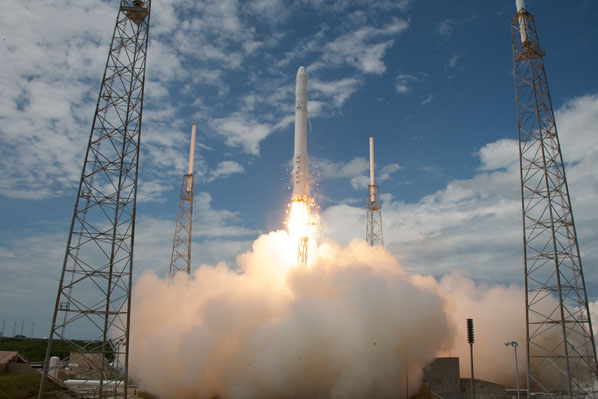
Falcon 9 Launch. Source: Chris Thompson/SpaceX
Hello and Welcome – I had a long interesting talk with the president of the Constellation Nation – ex officio – Mike Griffin. I asked him what he things about the success of Elon Musk’s Falcon 9 test launch – you may be surprised at his response – I also asked him about the latest skirmish in the war between old and new space. The full answer – and much more – coming up after we check the rest of the weeks space news.
Let’s get started with some fire and smoke – at the Baikonur Cosmodrome – that’s the site and sound of the 24th Space Station crew leaving earth behind for a long stint at the orbiting outpost. On board the Soyuz Capsule – Russian cosmonaut Fyodor Yurchikhin and NASA astronauts Shannon Walker and Doug Wheelock. Their arrival at the space station went well – the crew up there had an inkling they might be dropping by – so they dressed up in their fresh jumpsuits – and didn’t say they gave at the office their new station mates knocked on the door. The arrival of Shannon Walker marks a minor milestone in space for those of you who keep track of the stats. For the first time ever – two women are a part of the long duration crew at the same time. Right now there is no room at the ISS inn – 6 station keepers are up there…working in the coolest science lab anywhere.
Among the experiments on the schedule — A new way to take a look at the world’s shipping traffic. The ESA-sponsored experiment is using the ISS to track ships from space. All big ships are required to have on-board transponders, but the equipment really only works when the ship is close to shore.
The VHF radio signals that power the system have a horizontal range of just 40 nautical miles – so open ocean traffic is largely un-tracked. But, as it turns out, the vertical range of those radio waves is much greater…all the way up the space station. The experiment runs on remote control and will last for two years.
In the meantime, another NASA eye-in-the-sky is also keeping tabs on ships. The MODIS instrument on NASA’s Terra and Aqua satellites captured these views of what you might think of as ship “contrails.” It turns out the sulphur in a ship’s exhaust interacts with the water vapor over the ocean to form these bright streamers. They wouldn’t be visible to the naked eye, but MODIS can sniff them out.
David Waters is your host for the latest edition of “This Week In Space.” Check us out!
[youtubevid id=”T6sGcZRdj7U”]
Hayabusa. Source: JAXA
It was a nail biter – sample return missions always are – but in the end JAXA pulled it out and the troubled Japanese “Hayabusa” mission to land on an asteroid and collect a sample ended on a high note. A small capsule containing dust from the asteroid Itokawa touched down Sunday under parachute at the Woomera test range in the Australian Outback. Launched in May 2003, Hayabusa suffered a host of technical problems and malfunctions, but in the end came home. For those of you keeping score, NASA is 1 for 1 on sample return missions in recent years. The Genesis spacecraft, which returned a sample of the solar wind to Earth for analysis, cratered in the desert of Utah’s Dugway Proving Ground back in 2004 when its drogue parachute failed to deploy. Some of the sample return payload survived the crash, though. On a happier note, the Stardust spacecraft successfully returned a dust sample from the tail of the comet Wild 2 in 2006…also to the Dugway Proving Ground. And to answer your final question – yes, I know what it is – “Hayabusa” means “Peregrin Falcon.”
While the Japanese were celebrating, the South Koreans – well, no so much. They “had a bad day” on Thursday as they say in the rocket business. A Russian-built Naro-1 rocket launched from the Naro Space Center and all appeared fine at first, but mission controllers lost contact with it 137 seconds into flight. Korean news reports indicated it exploded and crashed. This is the second failure in two tries for the Koreans, who are attempting to establish a toehold in the satellite launch club. Currently, eight countries and Europe have established launch capability.
And, before we leave the Pacific Rim…What was that glowing spiral in the sky over Australia last Saturday morning? Could it be ALIENS? Well, as it turns out, no. It was actually Falcon 9. Despite the spate of UFO reports that were phoned in to TV stations around Australia, SpaceX founder Elon Musk told our friends at Space.com that folks were actually seeing Falcon 9 venting propellants after it rocketed to orbit. The sun caught the event at just the right angle to put on a show for the Aussies.
Thousands of contractor employees who work on the Constellation program have known the pink slips were coming ever since the Obama Administration announced plans to cancel the moon-shot project in February – but now it looks like they may be hitting the unemployment line earlier than they thought. NASA has told big contractors Lockheed Martin and ATK to come up with the money to cover the costs of bringing Constellation to an end, even though Congress has not signed off of the cancellation yet. It seems Lockmart and ATK are contractually required to pay those termination costs…which will total about a billion dollars. Now those companies will likely have to lay off workers to pull that money together. Expect this latest development to further poison the already nasty debate going on between the Administration, NASA and Congress over the future of the manned spaceflight program. We’ll have more on this for you in next week’s show.
 FIRE and smoke blasted out of the most powerful solid rocket motor designed for flight – a 5 segment solid rocket booster. This was a NASA and ATK test in Promontory Utah. It was a 75 million dollar test of a rocket that President Obama wants cancelled. This five segment motor was built to power the Ares I rocket meant to fly crews to space. This one blasted out a 600 foot long flame that was 5600 degrees and can generate up to 3.6 million pounds of thrust.



 Miles O'Brien